 Qurany Academy
- Posted on
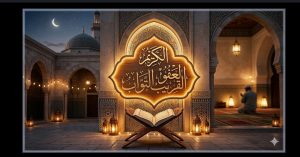
The Light of Allah’s Names: A Journey of the Heart During the Month of Fasting
There is no doubt, as scholars, educators, and behavioral experts agree, that sins and transgressions bear inevitable consequences and profound harm that directly impact the individual. Transgressions have affected his religion and mind, and extend to encompass his worldly life and the hereafter, bringing punishment and diminishing blessings. Qurany Academy will present this unique and fascinating article, “ The Light of Allah’s Names: A Journey of the Heart During the Month of Fasting,” which compiles many of Allah’s Beautiful Names.
Ramadan: A month of mercy and supreme attributes
The blessed month of Ramadan is a time of mercy, forgiveness, and deliverance from the fire. It is a great manifestation of the beautiful names and supreme attributes of Allah. At a time when the month is overflowing with the meanings of giving and blessing, we find that the beautiful names of Allah encompass the attributes of perfection with which the Creator, Glorified be He, manages the affairs of His servants. Hence, a close relationship arises between this holy month and the beautiful names, as the manifestations of Allah’s generosity, mercy, and forgiveness appear in their most beautiful forms during the days and nights of fasting.
Manifestations of the Most Beautiful Names in Ramadan
The names of Allah are vast and cannot be enumerated, and ninety-nine of them have been established in the Sunnah, all of which indicate greatness, majesty, and mercy. The following is a review of some of these names, whose impact is clearly evident in the lives of believers during Ramadan:
1. “Al-Rahman” and “Al-Rahim”(The Most Gracious, the Most Merciful)
The attributes of “Al-Rahman” and “Al-Rahim” are most manifest throughout the holy month of Ramadan, as Allah’s mercy extends to encompass everything. It is from His mercy that He prescribed fasting as a means of achieving piety and purifying the soul, in accordance with His words: (O you who have believed, decreed upon you is fasting as it was decreed upon those before you that you may become righteous). Another aspect of His mercy is the ease with which acts of worship are performed during this month by opening the gates of Paradise, closing the gates of Hell, and restraining the devils, which helps the believer to draw closer to his Lord.
2. The Name of Allah, At-Tawwab (The Acceptor of Repentance)
Ramadan is a month for forgiveness and repentance; Allah, the Almighty, grants His servants in this month double opportunities to seek forgiveness for sins and pardon for mistakes. The Prophet (PBUH)gave glad tidings to those who fast by saying: “Whoever observes fasts during the month of Ramadan out of sincere faith, and hoping to attain Allah’s rewards, then all his past sins will be forgiven”. Allah is the Forgiving One who opens the doors of hope to every repentant person, no matter how great their sins may be.
3. The Name of Allah, Al-Kareem (The Most Generous)
The effects of Allah’s generosity are most evident during the month of Ramadan, as He showers His servants with forgiveness and grace. Ramadan is a month of blessings because Allah’s favors upon His servants are greater during this time than at any other.
Allah is the All-Providing, the All-Powerful, the Generous, the One who loves generosity. He bestows abundantly upon those who fast, pray, and perform righteous deeds.
And increasing recitation of the Quran during Ramadan is superior to other forms of remembrance, for had other forms of remembrance been superior or equal in reward, they would have been prioritized. The fasting person should be keen to give charity abundantly during Ramadan, as the Prophet (peace and blessings be upon him) used to do.
4. The Name of Allah, “Al-‘Afw” (The Pardoner, The Most Forgiving)
The name “Al-‘Afw” is one of the most prominent names of this month, for forgiveness is a noble virtue that signifies the complete erasure of sin. Given the importance of this meaning, the Prophet (PBUH)guided us to seek it on Laylatul Qadr through the supplication.” For it is Allah, the Exalted, who overlooks sins and replaces them with good deeds by His grace and bounty.
On the Night of Decree (Laylat al-Qadr), the Prophet (peace and blessings be upon him) instructed Aisha (may Allah be pleased with her) to recite this supplication, and she said:
اللَّهُمَّ إِنَّكَ عَفُوٌّ تُحِبُّ الْعَفْوَ فَاعْفُ عَنِّي
“O Allah, You are Forgiving and love forgiveness, so forgive me”
5. The Name of Allah, Al-Qareeb (The Near/Close One): The Refuge and Fortress of the Repentant in Ramadan
The Name of Allah, “Al-Qareeb,” serves as a profound source of tranquility during Ramadan; for He, the Exalted, is Near through His knowledge, His hearing, and His response, as in His words: (And when My servants ask you, (O Muhammad), concerning Me- indeed I am Near). Allah accepts the supplications of those fasting, especially
Allah’s closeness manifests in Ramadan through the facilitation of acts of obedience, the shackling of the devils, and the opening of the gates of forgiveness. To achieve this, a Muslim must be sincere in worship, strive in prayer and remembrance, and return to Allah with sincere repentance that erases the traces of past sins.
The name of Allah, the Near One, is the gateway to hope; for in Ramadan, opportunities for private supplication increase, so that the believer may make up for what he has missed and rectify his conduct with the light of guidance.
True generosity in your life
Make your Ramadan a month for enriching the needy and bringing joy to every sad heart, and know that what you spend today is not a decrease in your wealth, but rather an increase and a blessing.
True generosity in your life is only complete with the refinement of your conduct, the sublimity of your morals, and your dealings with Allah’s servants with abundant tranquility and dignity. The fasting person who maintains composure when angry, and whose heart overflows with mercy when in conflict, is the one who has elevated his spirit above emotions, and he is the one who has understood the true meaning of fasting.
Among the Companions were those who exemplified generosity and kindness in their quest to please Allah:
Here is Abu Bakr, may Allah be pleased with him, spending all his wealth for the sake of Allah—not just once, but many times.
Here is ‘Umar, may Allah be pleased with him, giving half his wealth in charity during a military campaign; just imagine what he spent for the rest of his life.
“Then there is Talhah ibn ‘Ubaydullah (may Allah be pleased with him), one of the ‘Ten Promised Paradise.’ He was famously known as ‘Talhah al-Khayr’ (Talhah the Generous) due to his immense benevolence. Indeed, he was regarded as one of the most magnanimous figures among the Arabs in the history of Islam.”
Conclusion
Contemplating the Beautiful Names of Allah opens up vast horizons for the believer to come to know the Great Creator—Glory be to Him—especially during this blessed season, which abounds with the meanings of mercy, generosity, and guidance. Therefore, it is incumbent upon the Muslim to let his tongue utter these names, to reflect in his heart upon their meanings, and to use them as a means of communing with his Lord, in compliance with the words of the Exalted: “And to Allah belong the Most Beautiful Names, so invoke Him by them.” This spiritual journey is a path to strengthening certainty, ascending the ranks of nearness to Allah, and attaining the blessings of this noble month.